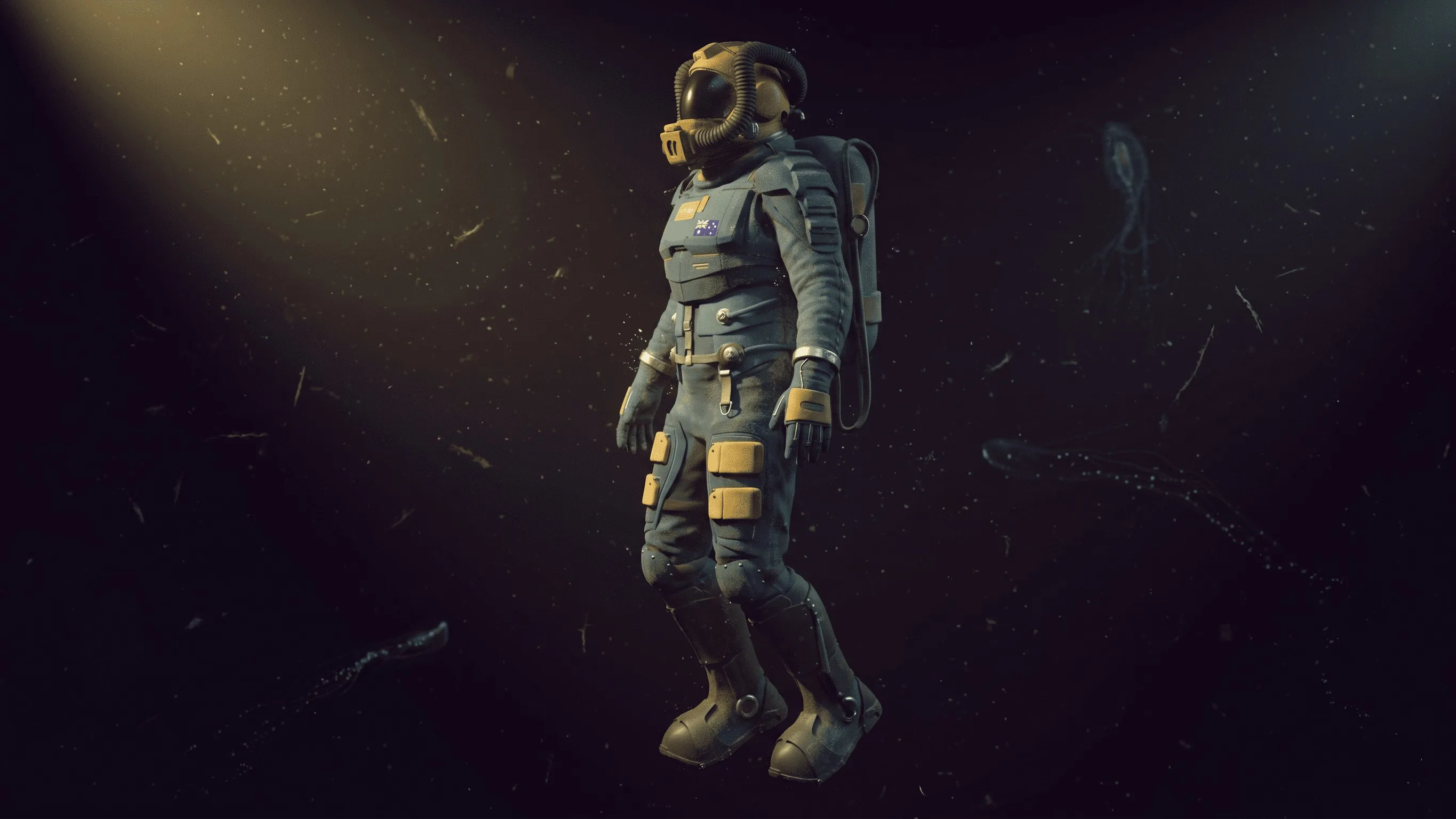
An offshore installation instruments everything that can fail. Gas detection, structural load, muster systems and lifeboat readiness are all monitored and drilled. The moment a person enters the water, monitoring stops. That is precisely the point at which the physiology becomes lethal in minutes rather than hours — and the point at which nobody knows the state of the individual they are trying to recover.
What the data shows
The first three minutes kill more people than hypothermia does.
On sudden immersion, heart rate rises from around 96 to 156 beats per minute and respiratory rate from 12 to 66 breaths per minute within the first minute. The response peaks at roughly 30 seconds, lasts two to three minutes, and is strongest between 10 and 15 °C. The literature is explicit that cold shock can kill or seriously incapacitate an individual long before general hypothermia develops.
Tipton MJ, Clin Sci 1989; Tipton MJ, Lancet 2003; Golden & Tipton.
Capable swimmers become unable to help themselves inside twenty minutes.
Once the cold-shock phase passes, cooling of superficial muscle and peripheral nerves degrades the extremities. Strong swimmers begin to struggle within ten to twenty minutes and within twenty to thirty minutes many are physically unable to maintain themselves in the water — through peripheral cooling, not hypothermia. Forearm muscle temperature falls faster than core temperature, progressively disabling grip and the swimming stroke while core temperature remains within normal range. The transition is largely invisible from the surface.
Tipton MJ, Extreme Environments Laboratory; Golden & Tipton, Essentials of Sea Survival.
Suits are certified in conditions that do not occur offshore.
Immersion suits are tested and certified in calm water. When the same protocols were run with wind, waves and 500 mL of water beneath the suit, predicted survival times fell markedly against a calm-water baseline that had exceeded 36 hours. Certified performance and delivered performance are not the same number, and only one of them is measured.
Power J, Simões Ré A et al., Appl Ergon 2015.
The common factor
In every finding above, the installation was instrumented and the person in the water was not.
Offshore survival is governed by some of the most developed emergency-response regimes in industry — helicopter underwater escape training, muster drills, suit certification and standby vessel coverage. Every element is designed around assumed physiological timelines drawn from calm-water testing on healthy volunteers. In an actual abandonment, nobody knows which of those assumptions is holding for which individual, because nothing is measuring them.
The Metakosmos approach
Metakosmos builds suits as platforms. Garment, life-support stack, sensing layer, validation programme and analytics are engineered as one system — so every abandonment becomes a measured event with a traceable record, rather than a procedure assumed to have worked.
Immersion detection, suit water ingress and skin temperature — the cold-shock window identified and timed from the first second.
Heart rate and rhythm through the initial response phase, where cardiovascular events are most likely and least observed.
Core temperature trend and motor-capacity indicators, distinguishing a survivor who can still self-rescue from one who cannot.
Position, orientation and casualty-state telemetry to the standby vessel and rescue coordinator, prioritising recovery order.
Two views of one platform
The test, laboratory and field-trial environment — built for the engineers who have to prove the claim.
- Protocol versioning and traceable test records
- Requirement-to-evidence chain, auditable on demand
- Exportable evidence packages for certification
The live operational dashboard, configurable by domain — air, space, sea and land.
- Casualty-state telemetry to the standby vessel and rescue coordinator
- Rescue-coordinator and medic views at differing density
- Sub-250 ms sensor-to-alert design target
Both are sensor-agnostic by design. Neither requires a Metakosmos suit to generate value — an operator can instrument the crews they already have, on the survival equipment they already carry.
Validation programme
Certification-equivalent calm-water testing plus wind-and-wave conditions with controlled suit water ingress.
Emergency donning under time pressure; inverted underwater egress; buoyancy characterisation against escape requirements.
Jump-entry and impact loading; harness and lifejacket integration; hard-point retention and sensor survivability.
SOLAS and the LSA Code; EN ISO 15027 immersion suits; UK CAA CAP 641; OPITO and NOPSEMA emergency-response requirements; MIL-STD-810.
Next steps
A closed session with the CTO and human-systems lead, worked against your operational profile. Outcome: capability brief and Q&A record.
An instrumented survival-training or muster exercise run against your own emergency-response profile. Outcome: data pack and integration assessment.
Installation- or fleet-scale deployment with sustainment and analytics. Outcome: in-service capability.
The position
The physiology of cold-water immersion has been characterised in detail for four decades, and the four-stage model of cold shock, incapacitation, hypothermia and circum-rescue collapse is settled science. What is missing is a platform that measures where a given individual actually sits on that curve, rather than assuming.
Sources
- Tipton MJ. The initial responses to cold-water immersion in man. Clin Sci 1989.
- Tipton MJ. Cold water immersion: sudden death and prolonged survival. Lancet 2003.
- Golden F, Tipton MJ. Essentials of Sea Survival.
- Power J, Simões Ré A et al. Reduction in predicted survival times in cold water due to wind and waves. Appl Ergon 2015.
- UK CAA CAP 641, Review of Helicopter Offshore Safety and Survival.
Request the full technical whitepaper
The full technical whitepaper includes protocol specifications, sensor validation data and integration requirements.
Request the full technical whitepaper