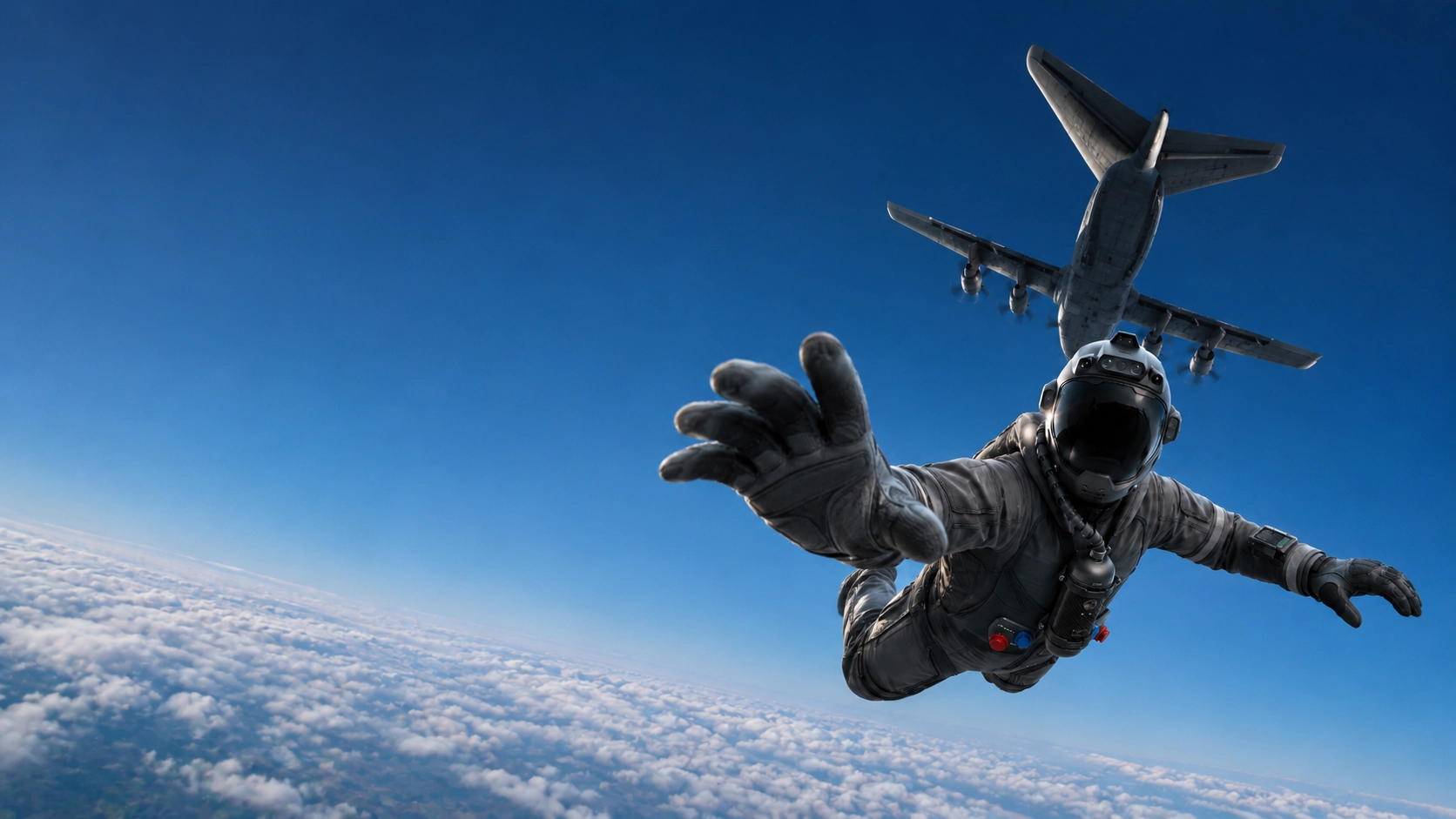
Every high-altitude platform in service is exhaustively instrumented. The person inside it is not. Cabin pressure, oxygen flow and airframe state are sampled continuously and logged. The operator's saturation, decompression load, thermal state and cognitive capacity are reconstructed afterwards — from a debrief, an incident report, or a hospital scan.
What the HALO and altitude DCS data shows
Decompression sickness is not a solved problem. It scales with operational tempo.
Across 1994–2010 there were 73 documented DCS cases among U-2 pilots, whose cabins sit at a pressure equivalent to roughly 29,500 ft. Risk per flight rose from 0.076% to 0.23%. Severe neurologic and pulmonary presentations more than doubled — 22 cases in five years against 10 in the preceding twelve. The increase tracked sortie frequency, not equipment failure.
Hundemer et al., Aviat Space Environ Med 2012; Jersey et al., 2011.
The injury persists after the sortie ends.
Imaging of high-altitude pilots treated for neurological DCS found a high burden of white-matter hyperintensities. Separate work reported measurably lower neurocognitive performance in U-2 pilots than in aircrew without repeated hypobaric exposure. One near-fatal in-flight case left permanent cognitive deficit with lesions visible on MRI. Repeated sub-clinical exposure appears to accumulate.
McGuire et al., 2012; Jersey et al., 2010; Neurology, 2014.
The freefall phase compresses the exposure, it does not remove it.
HALO exits are conducted above 25,000 ft, where time of useful consciousness on air is measured in tens of seconds and the pressure change through freefall is fast enough to produce barotrauma in a non-compliant Eustachian tube. The altitude exposure is short, but oxygen dependency during ascent and exit is absolute, and a regulator failure at exit gives the operator no useful window to diagnose it. Where the canopy phase extends that exposure, the decompression problem dominates instead.
Ottestad et al., J Appl Physiol 2017; FAA AC 61-107B.
Why HALO aircraft are instrumented and jumpers are not
In every finding above, the aircraft was instrumented and the human was not.
In every finding above, the aircraft was instrumented and the operator was not. The cost of that gap is visible in fast-jet aviation, where explaining a single spike in physiological episodes required a multi-year, multi-million-dollar root-cause investigation because the human side of the interaction had never been continuously recorded. Free-fall operations carry the same gap without the same investigative budget.
HALO and HAHO suits built as monitored platforms
Metakosmos builds suits as platforms. Garment, life-support stack, sensing layer, validation programme and analytics are engineered as one system — so every sortie and every jump becomes a measured event with a traceable record, rather than a procedure assumed to have worked.
Continuous SpO₂ and end-tidal CO₂ through mask and sensing garment — hypoxia onset detected before the operator can self-report it.
Prebreathe verification, cumulative hypobaric exposure and DCS-precursor modelling, personalised rather than applied as a fleet-wide assumption.
Core and skin temperature with extremity perfusion across a −45 °C envelope; cold degradation surfaced in real time.
Heart-rate variability, workload and acceleration response — the variables that determine whether a correct decision is still available.
Free-fall telemetry for the jumpmaster and the engineer
The test, laboratory and field-trial environment — built for the engineers who have to prove the claim.
- Protocol versioning and traceable test records
- Requirement-to-evidence chain, auditable on demand
- Exportable evidence packages for certification
The live operational dashboard, configurable by domain — air, space, sea and land.
- Intervention-grade alerting to the operator, full record to the ground
- Jumpmaster and flight-surgeon views at differing density
- Sub-250 ms sensor-to-alert design target
Both are sensor-agnostic by design. Neither requires a Metakosmos suit to generate value — an operator can instrument the crews and jumpers they already have, on the equipment they already fly.
Military free-fall suit validation programme
Hypobaric exposure to 35,000 ft equivalent; prebreathe verification; DCS bubble-detection screening; cognitive task batteries under simulated altitude.
Vertical wind-tunnel characterisation at 150–250 mph; equipment retention; helmet and mask seal integrity under aerodynamic load.
Cold-soak to −50 °C; extremity perfusion under sustained cold exposure; skin-temperature mapping.
FAA Part 105 / CASA Part 105; USPA B/C/D licensing and SIM oxygen procedures; AFI 11-409 and NATO STANAG free-fall doctrine; MIL-STD-810; MIL-STD-1472; DO-160.
How to engage on HALO and HAHO operations
A closed session with the CTO and human-systems lead, worked against your operational profile. Outcome: capability brief and Q&A record.
Instrumented sorties or jumps flown on your equipment, to your profile. Outcome: operator data pack and integration assessment.
Squadron-, unit- or dropzone-scale deployment with sustainment and analytics. Outcome: in-service capability.
The position
No incumbent supplier operates a unified hardware, software and validation platform engineered for the human at altitude. Sixty years of aerospace medicine has established what happens to people above 25,000 ft. The instrumentation to act on it in real time has existed for a decade. What is missing is a platform that puts the two together and treats the operator as a system worth measuring.
Sources
- Hundemer GL et al. Altitude decompression sickness incidence among U-2 pilots: 1994–2010. Aviat Space Environ Med 2012;83:968–74.
- Jersey SL et al. Neurological altitude DCS among U-2 pilots: 2002–2009. Aviat Space Environ Med 2011;82:673–82.
- Jersey SL et al. Severe neurological DCS in a U-2 pilot. Aviat Space Environ Med 2010;81:64–8.
- McGuire SA et al. Hyperintense white matter lesions in 50 high-altitude pilots with neurologic DCS. Aviat Space Environ Med 2012;83:1117–22.
- McGuire SA et al. Lower neurocognitive function in U-2 pilots. Neurology 2014.
- Eiken O, Elia A, Gottschalk F, Gennser M, Ånell R. Decompression strain in parachute jumpmasters during simulated high-altitude missions. Eur J Appl Physiol 2023.
- Ottestad W et al. Acute hypoxia in a simulated high-altitude airdrop scenario due to oxygen system failure. J Appl Physiol 2017.
- Webster AP, Reynolds OE. Time of consciousness during exposure to various pressure altitudes. US Navy BuMed 1946; FAA AC 61-107B.
- US Navy Physiological Episodes Action Team root-cause findings, 2020; NAVAIR 2019.
Request the full technical whitepaper
The full technical whitepaper includes protocol specifications, sensor validation data and integration requirements.
Request the full technical whitepaper