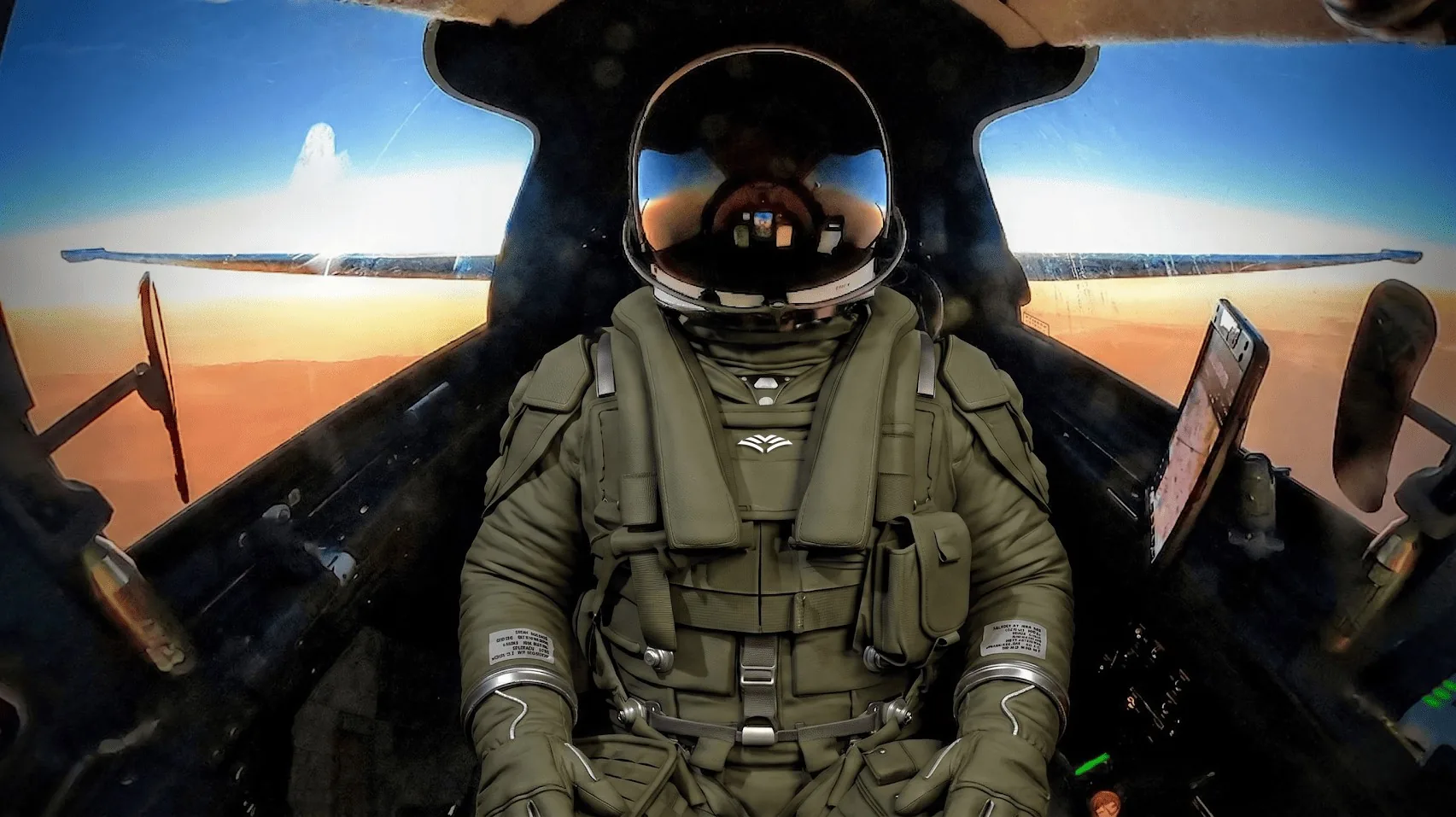
A modern aircraft instruments every subsystem to the millisecond. The pilot is not. Cabin pressure, oxygen delivery, G-loading and airframe state are logged continuously; the aircrew's oxygenation, G-tolerance, cognitive state and cumulative fatigue are reconstructed afterwards — from a debrief, an incident report, or a mishap investigation.
What the aircrew physiological episode data shows
Unexplained physiological episodes rose faster than anyone could explain them.
The US Navy recorded a physiological-episode rate reaching 71 per 100,000 flight hours in the T-45 in 2017 — the highest ever documented. Explaining it took roughly three years, about US$50 million, more than 8,000 pages of analysis and 567 recommendations. The finding was a complex interaction between aircrew, life-support equipment and aircraft — an interaction whose human side had never been continuously recorded.
US Navy Physiological Episodes Action Team root-cause findings, 2020; NAVAIR 2019.
Hypoxia is insidious precisely because the pilot cannot feel it coming.
At altitude the onset of hypoxia degrades judgement before the individual registers any symptom, and time of useful consciousness collapses with altitude — from minutes at 25,000 ft to seconds above 40,000 ft. On-board oxygen generating systems fail in ways that are invisible to the aircrew until performance is already compromised, which is why the physiological signal, not the equipment signal, is the one that matters.
Webster AP, Reynolds OE, US Navy BuMed 1946; FAA AC 61-107B.
G-tolerance and fatigue are individual, and neither is measured in the seat.
Sustained high-G loading drives G-induced loss of consciousness, and tolerance varies widely between individuals and across a single sortie with hydration, fatigue and workload. Long-duration and multi-sortie operations accumulate a fatigue load that shapes decision quality. These are per-pilot variables, and current practice manages them by procedure and assumption rather than by measurement. Anti-G suits and straining manoeuvres raise the threshold, but neither reports whether a given pilot is approaching theirs on a given sortie.
Aerospace medicine G-tolerance literature; aircrew fatigue and sustained-operations studies.
Why aircraft are instrumented and aircrew are not
In every finding above, the aircraft was instrumented and the aircrew was not.
Fast-jet and high-altitude flight are among the most heavily telemetered activities on Earth, and almost all of that telemetry describes the machine. The pilot's oxygenation, G-response, workload and fatigue are inferred after the sortie. A physiological-episode investigation costs what it does precisely because the human side of the interaction was never recorded while it was happening.
High-altitude pilot suits built as monitored platforms
Metakosmos builds suits as platforms. Garment, life-support stack, sensing layer, validation programme and analytics are engineered as one system — so every sortie becomes a measured event with a traceable record, rather than a procedure assumed to have worked.
Continuous SpO₂ and end-tidal CO₂ through the mask and sensing garment — hypoxia onset detected before the aircrew can self-report it.
Cardiovascular and acceleration response through the manoeuvre envelope, surfacing G-tolerance degradation before loss of consciousness — measured on the aircrew rather than assumed from the G-suit's inflation schedule.
Heart-rate variability, workload and reaction indicators — the variables that determine whether a correct decision is still available.
Cumulative sortie and multi-day fatigue modelling, tracked per aircrew rather than applied as a fleet-wide assumption.
Aircrew telemetry for the flight surgeon and the engineer
The test, laboratory and field-trial environment — built for the engineers who have to prove the claim.
- Protocol versioning and traceable test records
- Requirement-to-evidence chain, auditable on demand
- Exportable evidence packages for certification
The live operational dashboard, configurable by domain — air, space, sea and land.
- Intervention-grade alerting to the aircrew, full record to the ground
- Aircrew and flight-surgeon views at differing density
- Sub-250 ms sensor-to-alert design target
Both are sensor-agnostic by design. Neither requires a Metakosmos suit to generate value — an operator can instrument the aircrew they already have, on the aircraft they already fly.
High-altitude flight suit validation programme
Hypobaric exposure across the operational envelope; oxygen-system-failure scenarios; hypoxia-onset detection screening.
Centrifuge characterisation across sustained-G profiles; G-tolerance and loss-of-consciousness precursor validation.
Cockpit thermal-load characterisation; sortie-duration endurance and fatigue runs under representative workload.
CASA and FAA airworthiness frameworks; MIL-STD-810; MIL-STD-1472; DO-160; relevant military aircrew life-support standards.
How to engage on aircrew monitoring
A closed session with the CTO and human-systems lead, worked against your operational profile. Outcome: capability brief and Q&A record.
Instrumented sorties flown on your aircraft, to your profile. Outcome: aircrew data pack and integration assessment.
Squadron- or fleet-scale deployment with sustainment and analytics. Outcome: in-service capability.
The position
No incumbent supplier operates a unified hardware, software and validation platform engineered for the human in the cockpit. Aerospace medicine has characterised hypoxia, G-tolerance and fatigue for decades, and the instrumentation to act on them in real time exists. What is missing is a platform that puts the two together and treats the aircrew as a system worth measuring.
Other air domain briefs
Sources
- US Navy Physiological Episodes Action Team root-cause corrective action findings, 2020; NAVAIR 2019.
- Webster AP, Reynolds OE. Time of consciousness during exposure to various pressure altitudes. US Navy BuMed 1946; FAA AC 61-107B.
- US Naval aviation physiological episode reviews, F/A-18 and T-45 platforms.
- Aerospace medicine literature on G-induced loss of consciousness and aircrew G-tolerance.
- Aircrew fatigue and sustained-operations performance studies.
Request the full technical whitepaper
The full technical whitepaper includes protocol specifications, sensor validation data and integration requirements.
Request the full technical whitepaper