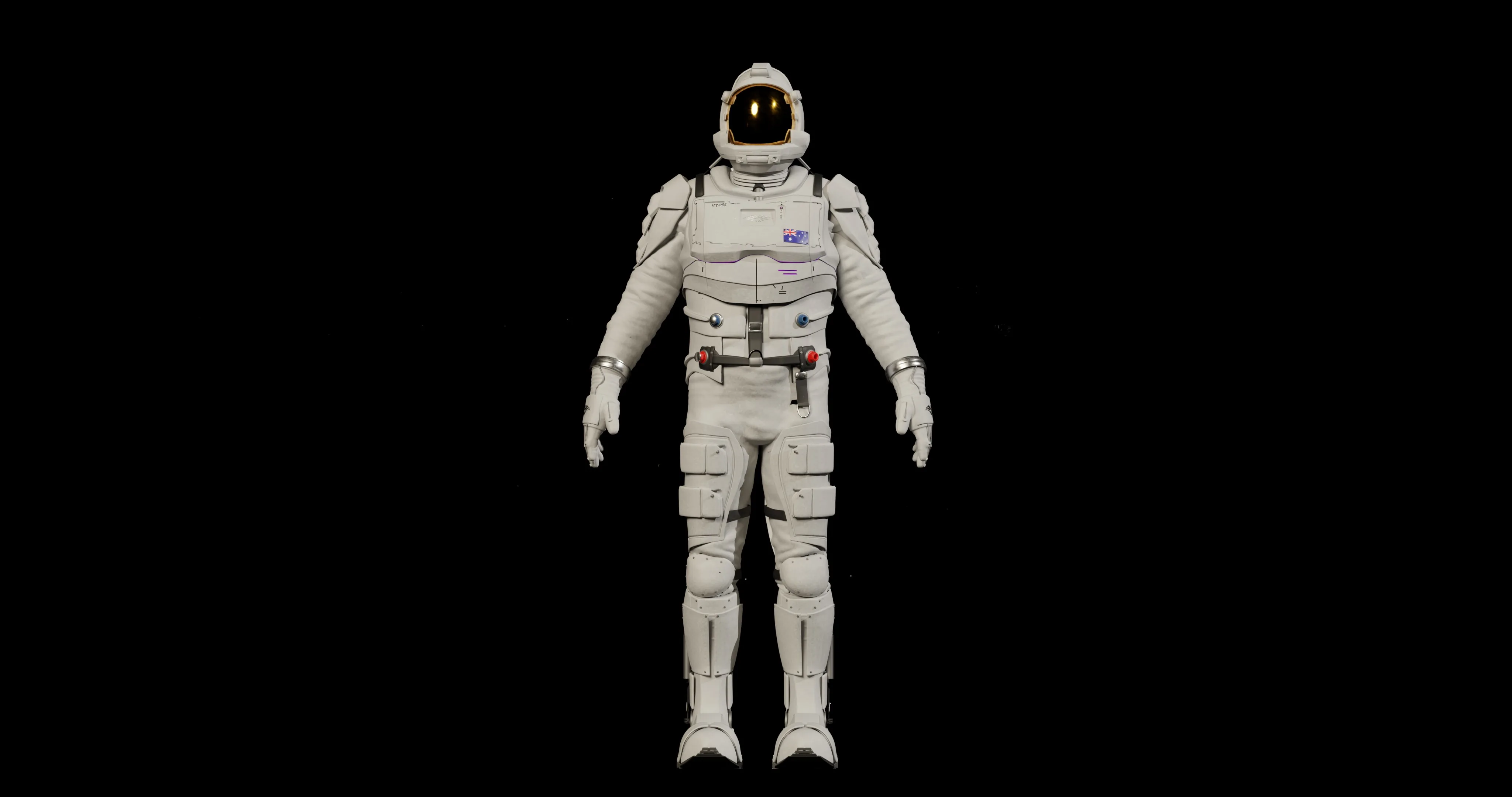
An EVA suit is one of the most instrumented objects ever built. Pressure, oxygen, CO₂ scrubbing, cooling loop, battery and comms are telemetered to the ground continuously. The crewmember inside it is not. Physiological monitoring amounts to a single-lead ECG and a voice loop, and the injury record is assembled after the fact from post-EVA debriefs and a surveillance database.
What the EVA injury data shows
Suited work injures crew at a rate that would be unacceptable anywhere else.
Across 770 suited training sessions with 86 astronaut subjects, symptoms were reported in 352 sessions — 45.7% of the total. Of those, 47% involved the hands, 21% the shoulders and 11% the feet. Hand symptoms were predominantly fingernail delamination, attributed to moisture in the gloves and axial loading of the fingertips. In flight, interaction with suit components accounted for 0.26 musculoskeletal injuries per EVA.
Strauss S, NASA 2004; Scheuring RA et al., Aviat Space Environ Med 2009; NASA Human Research Program.
The injury signature is consistent across three decades and still not predicted.
A retrospective review of the Lifetime Surveillance of Astronaut Health database identified 196 EVA training and in-flight injury incidents to the distal upper extremity between 1981 and 2010, with more than 400 associated signs and symptoms. Hand circumference and metacarpophalangeal joint width were found to be significantly associated with injury susceptibility. The anthropometric risk factors are known — but nothing measures the loading as it happens.
Charvat J et al., NASA/TP 2015; Opperman R, MIT thesis, 2010.
In the extreme cases, the outcome is surgical.
Fingernail delamination and rotator cuff tears arising from EVA training and operations have required medical or surgical intervention, and NASA convened a dedicated shoulder injury tiger team to examine the relationship between shoulder injury and neutral buoyancy training. With Artemis-era EVA cadence rising and commercial EVA now a reality, a per-EVA injury rate becomes a programme-level constraint rather than a medical footnote.
Williams DR, Johnson BJ, NASA JSC Shoulder Injury Tiger Team; Chappell S et al., NASA JSC.
Why EVA suits are telemetered and astronauts are not
In every finding above, the suit was instrumented and the crewmember was not.
EVA is the most telemetered human activity ever conducted, and the telemetry is almost entirely about the machine. Consumables and life-support margins are known to the second on the ground. Crew loading, thermal state, workload and injury mechanism are reconstructed afterwards from debriefs and surveillance databases. The result is a body of injury data three decades deep that describes what happened, and nothing that predicts it during the sortie.
EVA suits built as monitored platforms
Metakosmos builds suits as platforms. Garment, life-support stack, sensing layer, validation programme and analytics are engineered as one system — so every sortie becomes a measured event with a traceable record, rather than a procedure assumed to have worked.
Glove contact pressure, digit loading and shoulder joint kinematics — the documented injury mechanisms, measured while they are occurring.
Metabolic rate, core and skin temperature and cooling-loop demand tracked against the planned sortie timeline.
SpO₂ and localised CO₂ washout at the helmet, measured independently of the suit's own life-support telemetry.
Prebreathe verification and individualised DCS risk modelling across the sortie and across the mission.
EVA telemetry for the flight surgeon and the engineer
The test, laboratory and field-trial environment — built for the engineers who have to prove the claim.
- Protocol versioning and traceable test records
- Requirement-to-evidence chain, auditable on demand
- Exportable evidence packages for certification
The live operational dashboard, configurable by domain — air, space, sea and land.
- Intervention-grade alerting to the crew, full record to the flight surgeon
- Crew and flight-surgeon views at differing density
- Sub-250 ms sensor-to-alert design target
Both are sensor-agnostic by design. Neither requires a Metakosmos suit to generate value — an operator can instrument the crews they already train, in the suits and analogues they already use.
EVA suit validation programme
Qualification across the extravehicular thermal and pressure envelope; cooling-loop characterisation under representative workload.
Glove pressure mapping and digit-loading characterisation; shoulder kinematics in neutral buoyancy and reduced-gravity analogues.
Cognitive and dexterity task batteries under pressurised suited conditions; sortie-duration endurance and fatigue runs.
NASA-STD-3001 human systems integration; NASA-STD-6016; NASA NPR 7123.1 and the TRL framework; MIL-STD-1472 human factors.
How to engage on EVA monitoring
A closed session with the CTO and human-systems lead, worked against your operational profile. Outcome: capability brief and Q&A record.
An instrumented analog or neutral-buoyancy campaign run against your own EVA profile. Outcome: crew data pack, biomechanical analysis and integration assessment.
Programme-scale deployment with sustainment and analytics. Outcome: in-service capability.
The position
Three decades of surveillance data describe EVA injury with precision, and suit telemetry is mature. What is missing is a layer that instruments the crewmember at the same fidelity as the suit — so injury mechanisms are caught during the sortie rather than characterised after the programme.
Other space domain briefs
Sources
- Strauss S. Extravehicular mobility unit training and astronaut injuries. NASA 2004.
- Scheuring RA et al. Musculoskeletal injuries and minor trauma in space: incidence and injury mechanisms in U.S. astronauts. Aviat Space Environ Med 2009.
- Charvat J et al. Spacesuit glove-induced hand trauma and analysis of potentially related risk variables. NASA/TP 2015.
- Opperman R. Astronaut EVA: safety, injury and countermeasures. MIT 2010.
- Williams DR, Johnson BJ. NASA JSC Shoulder Injury Tiger Team.
- Chappell S et al. Risk of injury and compromised performance due to EVA operations. NASA JSC; NASA Human Research Roadmap, EVA Suit evidence report.
Request the full technical whitepaper
The full technical whitepaper includes protocol specifications, sensor validation data and integration requirements.
Request the full technical whitepaper