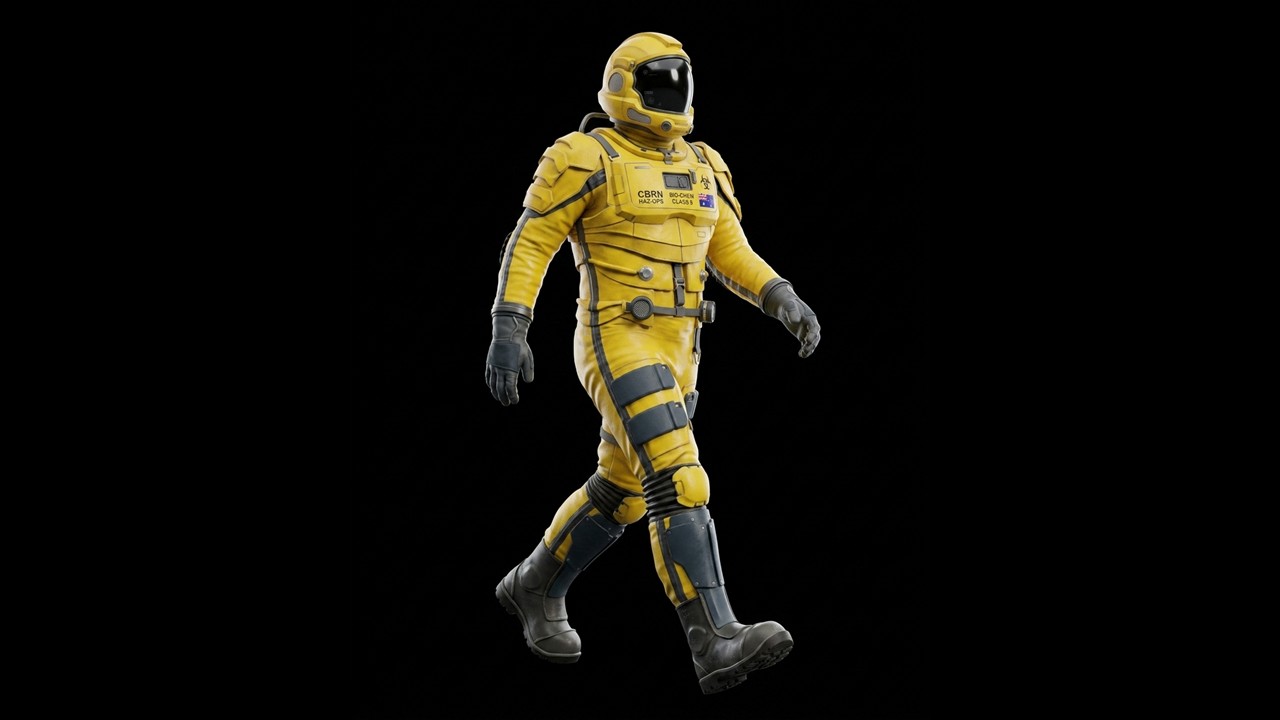
In a CBRN entry, every threat outside the suit is measured. Agent concentration, plume model, dose rate and hot-zone boundary are instrumented and mapped. Inside the suit, there is a stopwatch. The operator is working toward a physiological limit in an ensemble that cannot shed heat, and the only instruments observing them are a radio check and an entry time drawn from a table.
What the CBRN tolerance-time data shows
Tolerance time is not a number. It is a distribution.
Across controlled trials in an encapsulating protective ensemble at wet bulb globe temperatures of 21, 30 and 37 °C and walking speeds from 2.5 to 5.5 km/h, measured tolerance times ranged from 10 to 60 minutes. Environment and work rate moved the figure by a factor of six. A single planning number for entry duration cannot describe that range — and the operators inside the ensembles are not identical to one another either.
Physiological tolerance times in protective clothing under simulated environmental extremes, PLOS ONE 2014.
The limit that stops the operator is cardiovascular, and nobody is watching it.
Across 108 trials in explosive and chemical protective equipment, 78.7% were terminated because heart rate exceeded 90% of maximum — the dominant termination criterion by a large margin. Core temperature exceeded 39 °C in only 5.6% of trials and volitional fatigue in 8.3%; the remainder from other investigator criteria. Cardiovascular strain, not thermal load, is the binding constraint on encapsulated work — and heart rate is the one variable that is trivially measurable and almost never measured in the hot zone.
Metabolic work rate, ambient environment and tolerance times in protective equipment, Biomed Res Int 2015.
Full encapsulation lowers the temperature at which the operator fails.
In fully encapsulating protective clothing, the evaporative cooling required to maintain thermal balance exceeds what the environment can absorb, so body heat storage rises continuously until exhaustion. Fully encapsulated subjects reached exhaustion at a lower core temperature than partially clothed subjects. The ensemble protecting the operator from the agent is also the thing removing their ability to shed heat — and it moves their failure point downward.
Uncompensable heat stress in protective clothing, J Appl Physiol; McLellan TM, Daanen HA, Cheung SS, Compr Physiol 2013.
Why the threat is instrumented and the responder is not
In every finding above, the threat was instrumented and the responder was not.
CBRN and hazmat doctrine is built around measured external hazard and estimated internal endurance. Entry times are set from tables, adjusted by a safety officer's judgment and enforced by radio. Given a measured tolerance range of ten to sixty minutes across conditions, and a binding constraint that is cardiovascular rather than thermal, a table-driven entry time is a population average applied to an individual — at the moment when getting it wrong means a second casualty inside a contaminated boundary.
CBRN and hazmat suits built as monitored platforms
Metakosmos builds suits as platforms. Garment, life-support stack, sensing layer, validation programme and analytics are engineered as one system — so every entry becomes a measured event with a traceable record, rather than a procedure assumed to have worked.
Continuous heart rate against individual maximum — the actual limiting variable, alerted before 90% of maximum is reached.
Core and skin temperature with heat-storage rate, so remaining safe entry time is calculated per operator rather than assumed.
Seal integrity, respirator flow and cartridge-life telemetry; breach detection and cumulative exposure dose.
Entry timing, position within the hot zone and decontamination workflow state, held per operator and visible to the safety officer.
Hot-zone telemetry for the safety officer and the engineer
The test, laboratory and field-trial environment — built for the engineers who have to prove the claim.
- Protocol versioning and traceable test records
- Requirement-to-evidence chain, auditable on demand
- Exportable evidence packages for certification
The live operational dashboard, configurable by domain — air, space, sea and land.
- Intervention-grade alerting to the operator and safety officer
- Safety-officer and medic views at differing density
- Sub-250 ms sensor-to-alert design target
Both are sensor-agnostic by design. Neither requires a Metakosmos suit to generate value — an operator can instrument the responders they already have, on the ensembles they already field.
CBRN suit validation programme
Climatic chamber human-in-the-loop testing across WBGT bands and work intensities; tolerance-time characterisation per configuration.
Permeation, penetration and barrier testing against representative agents; seal and interface integrity under working load.
Quantitative fit testing; flow and breakthrough verification across the respirator hierarchy from filtering facepiece to SCBA.
AS/NZS 1715 and 1716; WHS Regulations; ISO 45001; NFPA 1991 and 1994 equivalents; NATO AEP CBRN protection standards; MIL-STD-810.
How to engage on CBRN and hazmat operations
A closed session with the CTO and human-systems lead, worked against your operational profile. Outcome: capability brief and Q&A record.
Instrumented entries run against your own hot-zone profile and ensemble. Outcome: operator data pack, tolerance-time characterisation and integration assessment.
Unit- or service-scale deployment with sustainment and analytics. Outcome: in-service capability.
The position
The physiology of encapsulated work has been characterised in controlled conditions for decades, and the binding constraint is known to be cardiovascular. What is missing is a platform that puts that measurement in front of the safety officer while the entry is running, rather than in a chamber study afterwards.
Other land domain briefs
Sources
- Physiological tolerance times while wearing explosive ordnance disposal protective clothing in simulated environmental extremes. PLOS ONE 2014.
- The effects of metabolic work rate and ambient environment on physiological tolerance times while wearing explosive and chemical personal protective equipment. Biomed Res Int 2015.
- McLellan TM, Daanen HA, Cheung SS. Encapsulated environment. Compr Physiol 2013.
- Uncompensable heat stress in protective clothing, J Appl Physiol.
- Safe Work Australia, model Codes of Practice; AS/NZS 1715 and 1716.
Request the full technical whitepaper
The full technical whitepaper includes protocol specifications, sensor validation data and integration requirements.
Request the full technical whitepaper